Vesuvius Challenge · Get started
One scroll read.
You could read the next.
The first scroll has been read, and the people who read it were newcomers not long before: students, engineers, tinkerers who found this project and stayed. Hundreds of scrolls remain sealed, and $2,140,000 in prizes is on the table for whoever helps open them. Come claim a piece of it.
Here's what the work actually looks like, where you'd fit in it, and what to do first.
Part 1 · Read
Can you find the ink?
Train your first ink model.
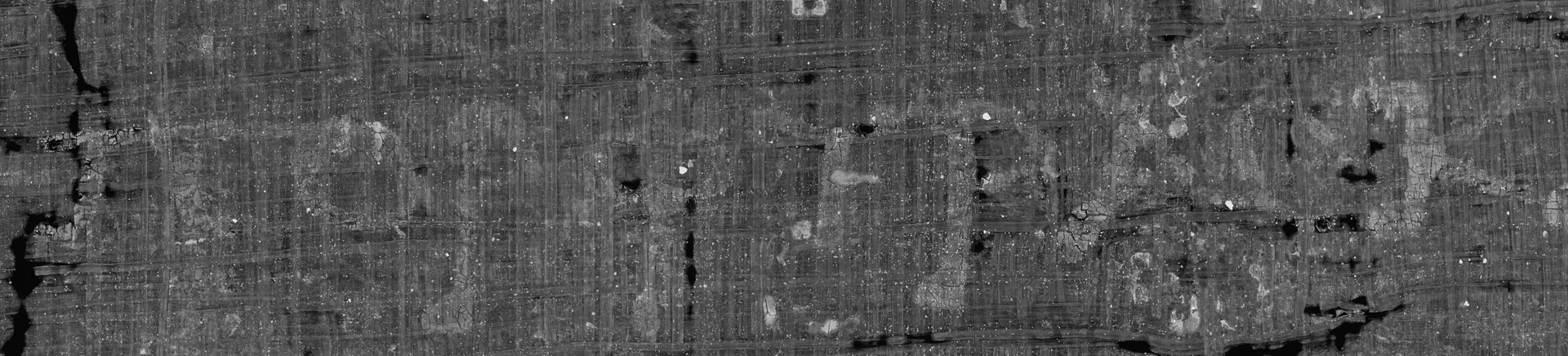
The ink is carbon. So is the scorched papyrus underneath it. To an X-ray the two look nearly identical. But one scroll's ink cracked as it dried, and a person spotted the faint texture by eye. Those cracks gave up the first words ever read from inside an unopened scroll. Most scrolls give away less, so models have since learned to catch traces that can slip past even the eye.
This is easier to try than to explain, so here's a piece of that same scroll. Paint the ink you can see, and a model trains on your labels to predict the rest. It's only as good as the labels you give it.
Part 2 · Unwrap
Where did that surface come from?
Trace your first surface.
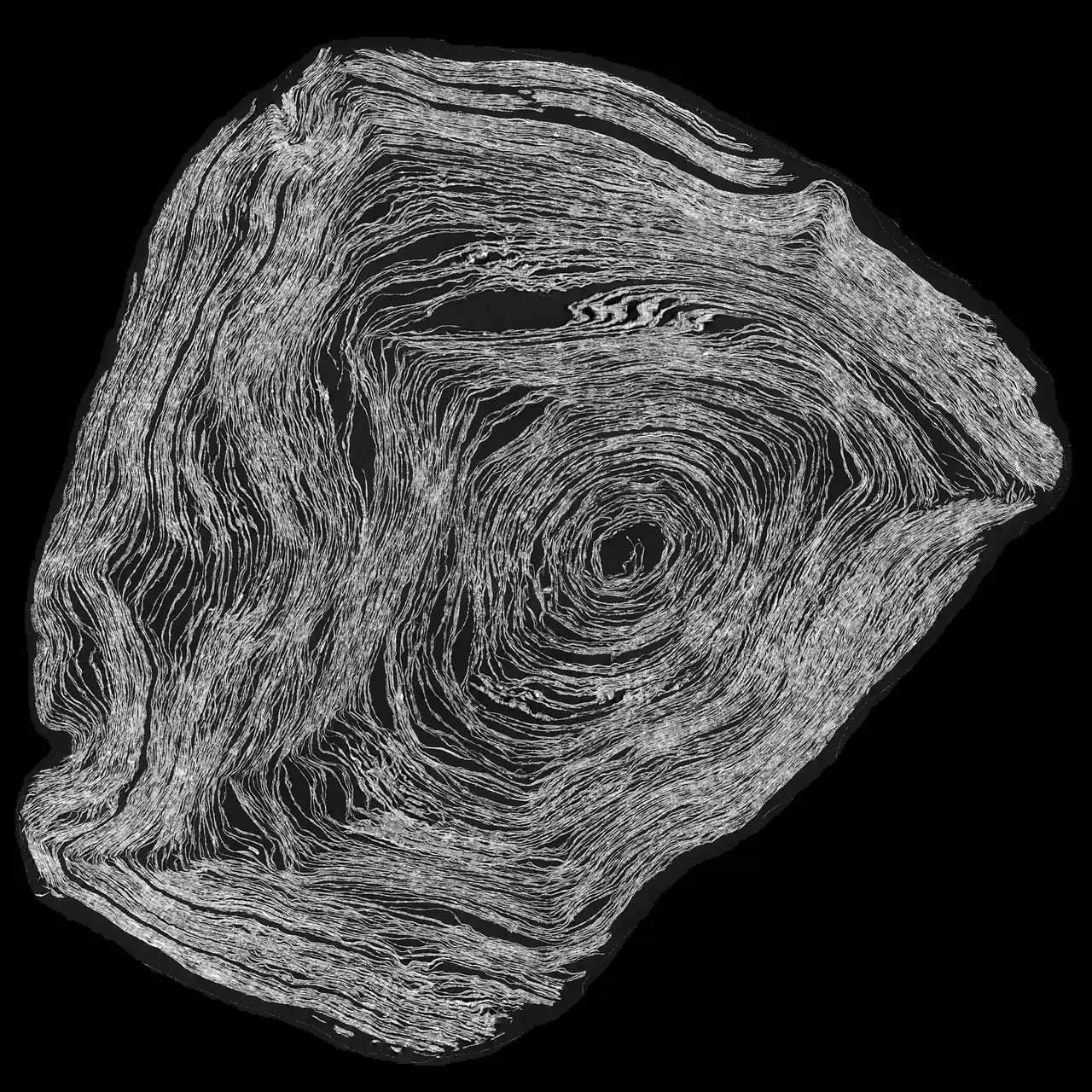
Now rewind one step. You just read ink off a flat surface, but nothing in a rolled scroll is flat. A CT scan gives us a billion voxels of a single sheet wound around itself hundreds of times, crushed and torn by the eruption. Before anyone can look for ink, that sheet has to be found, traced, and flattened. We call it virtual unwrapping.
Below is real data from PHerc. Paris 4, and the same sheet you read the word from in Part 1. Click where the scroll pulses to open a cross-section. Every thin bright line in it is one layer of the rolled-up sheet. Follow a single layer with your dots and the flattened surface builds on the right. Drift onto a neighboring layer and it smears.
The full pipeline
It works. It doesn't scale yet.
Scan, unwrap, read. You've now done all three, just very small. At full size a scroll is several terabytes of CT data, a surface runs for meters through hundreds of turns, and parts of the tracing still need a human in the loop. The first scroll settled whether any of this is possible. The prizes are for scaling the methods up, so the entire library can finally be read.
Open Problems lists what's still unsolved, and how to start on each one. The Grand Prize deadline is June 25, 2027.
Pick your path
Where do you fit?
I think in geometry
You just traced one layer of a scroll by hand. A real scroll has hundreds, crushed together and torn, and reading the library means software that follows them on its own. It's a hard surface-reconstruction problem: meshes, optimization, 3D vision.
2027 Grand Prize · $1,000,000
Read the open problems →I train models
You just trained the toy version. Real ink detection works the same way: a computer-vision problem with 2,000-year-old labels, and the tutorial takes you from download to a first prediction in a weekend. Better predictions can win prizes and uncover more unseen text.
First Letters · up to $500,000
Ink detection tutorial →I build tools
Most of the software here was written by people in the community: viewers, data loaders, training code. The best open-source contribution each month wins $20,000.
Progress Prizes · $590,000 / year
See the tools →I'm just curious
Everything here is open: the scans, the renders, the recovered text. All of it is a browser tab away, and following along closely is how many contributors started.
No setup · no deadline
Open the Data Browser →Still deciding? The technical frontier is in Open Problems, the data is all open, and the FAQ covers the rest.
Track record
Former winners were newcomers too.
The first word ever read from inside a sealed scroll was ΠΟΡΦΥΡΑϹ, purple, the word you uncovered in Part 1. It was found by a student who had joined the community only months earlier. The $1,868,000 awarded since has gone mostly to individuals and small teams. Many of them first met on Discord.
Last step
Join the community.
Every path above starts in the same place. Come introduce yourself and ask anything: the Vesuvius Challenge team is around every day, and so are contributors who have hit every wall before you and are glad to help you past them.
Questions? [email protected]